How to Size a Ground Wire (Equipment Grounding Conductor)
The short version
- Two different conductors get called "ground wire": the equipment grounding conductor (EGC, NEC 250.122) and the grounding electrode conductor (GEC, NEC 250.66). This guide is about the EGC.
- EGC size is driven by the ampere rating of the overcurrent device protecting the circuit, not by the run length or the gauge of the hot conductors.
- If you upsized the hot conductors for voltage drop or derating, NEC 250.122(B) requires you to upsize the EGC proportionally too.
- NMB (Romex) cable ships with a factory-matched ground, so there is nothing to calculate for standard branch circuits.
- Run length has no bearing on the EGC minimum. A 6-foot circuit and a 150-foot circuit on the same 30-amp breaker use the same minimum ground wire.
Sizing a ground wire trips up a lot of people because there are actually two different grounding conductors in an electrical system, each with its own sizing rule. Get them confused and you'll either oversize (wasting money) or undersize (creating a safety hazard). This guide focuses on the equipment grounding conductor (EGC) and how to size it correctly using NEC Table 250.122.
Always verify sizing against the current edition of the NEC and consult a licensed electrician before doing live electrical work.
EGC vs. Grounding Electrode Conductor: Know the Difference
These two conductors serve different purposes and are sized by completely different rules.
The equipment grounding conductor (EGC) runs alongside the circuit conductors inside a raceway or cable assembly. Its job is to give fault current a low-impedance return path back to the source so the overcurrent protective device (breaker or fuse) trips quickly. NEC 250.122 governs EGC sizing, and the key variable is the rating of the overcurrent device protecting the circuit, not the wire gauge you selected for the hot conductors.
The grounding electrode conductor (GEC) connects the system neutral to the grounding electrode system (ground rods, water pipe, etc.) at the service. NEC 250.66 governs it, and sizing is based on the largest service-entrance conductor. The GEC does not carry fault current during normal operations; it establishes a voltage reference.
If someone hands you a single "ground wire size" question without telling you which conductor they mean, ask. The two numbers can be very different for the same service.
How to Use NEC Table 250.122
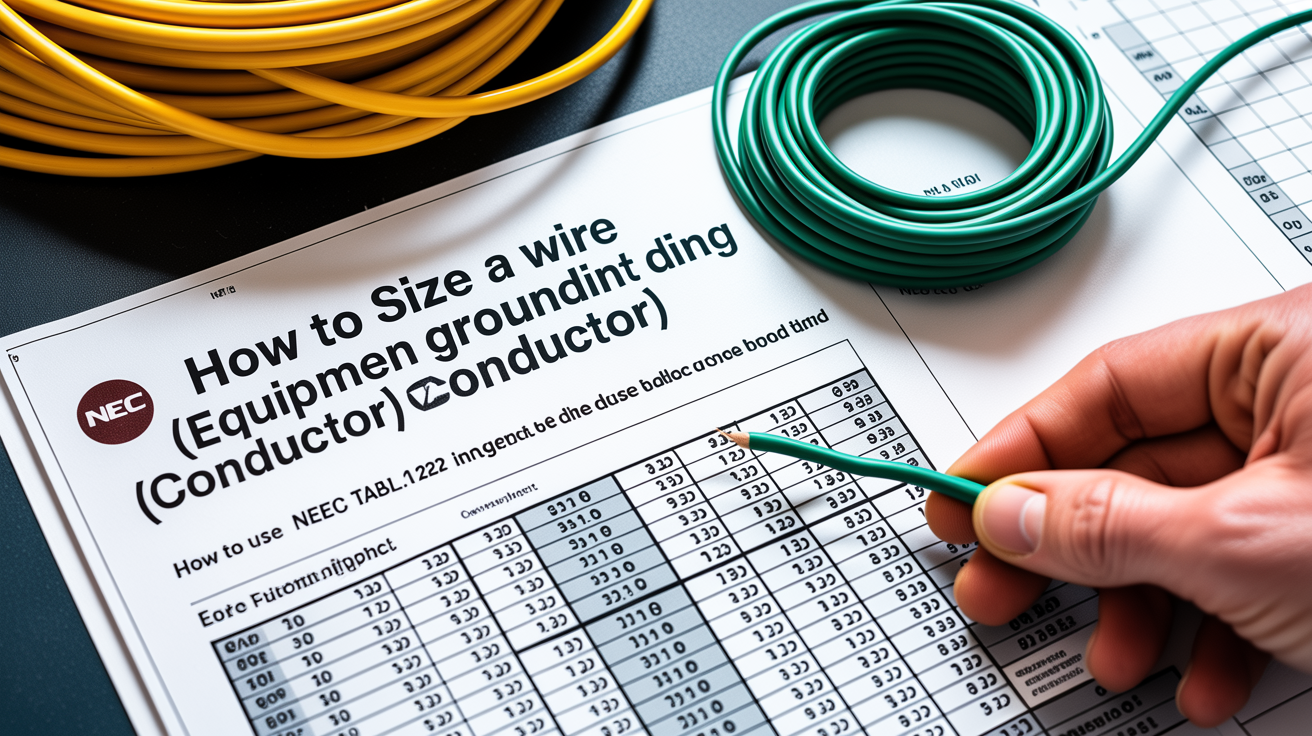
The table is straightforward once you understand its structure. You look up the ampere rating of the overcurrent device protecting the circuit and read across to find the minimum copper EGC size (or aluminum/copper-clad aluminum, which runs two sizes larger in most cases).
Here is a condensed version of the copper EGC minimums from Table 250.122:
| OCPD Rating (Amps) | Min. Copper EGC |
|---|---|
| 15 | 14 AWG |
| 20 | 12 AWG |
| 30 | 10 AWG |
| 40 | 10 AWG |
| 60 | 10 AWG |
| 100 | 8 AWG |
| 200 | 6 AWG |
| 300 | 4 AWG |
| 400 | 3 AWG |
| 500 | 2 AWG |
| 600 | 1 AWG |
| 800 | 1/0 AWG |
| 1000 | 2/0 AWG |
| 1200 | 3/0 AWG |
| 1600 | 4/0 AWG |
| 2000 | 250 kcmil |
For OCPD ratings that fall between table values, use the next higher rating listed. A 70-amp breaker falls between 60 and 100, so you'd look at the 100-amp row and use 8 AWG copper.
For aluminum or copper-clad aluminum EGCs, the NEC permits those materials but the minimum sizes are larger. Many installers default to copper for EGCs regardless, especially for smaller circuits, because the size difference is negligible and copper is easier to terminate reliably.
The Upsize Rule: When the EGC Must Grow
There is one situation where following Table 250.122 directly gives you an undersized EGC: when the ungrounded (hot) conductors have been upsized from their minimum allowable size.
NEC 250.122(B) requires you to proportionally increase the EGC whenever the circuit conductors are larger than required. The formula is:
New EGC area = (Actual conductor area / Required conductor area) × Table 250.122 EGC area
This rule exists because fault current magnitude depends on the impedance of the fault-return path. If you ran bigger hots (lower impedance), the fault current will be higher, and a proportionally larger EGC is needed to carry that current without overheating before the breaker clears.
Common scenarios where 250.122(B) applies:
- Long runs where you upsized for voltage drop reasons (see how to size wire for a subpanel for voltage drop context)
- Parallel conductor sets, where each set needs its own EGC sized to each set's conductors
- Circuits where the engineer specified larger conductors for derating due to conduit fill or ambient temperature
If you upsized from 10 AWG to 8 AWG on a 30-amp circuit, you cannot just leave the EGC at 10 AWG and call it done. You need to run the proportion.
Worked Example: 200-Amp Subpanel Feed
Say you're running a feeder to a detached garage subpanel. The main panel has a 200-amp breaker protecting the feeder.
Step 1: Find the minimum EGC from Table 250.122. The 200-amp row gives you 6 AWG copper.
Step 2: Check whether you upsized the hot conductors. The minimum conductor for a 200-amp circuit (after applying the appropriate ampacity table and derating) might be 3/0 AWG copper in conduit. Suppose you decided to run 350 kcmil copper instead, to keep voltage drop under 2% on a 120-foot run. That is an upsize, so 250.122(B) kicks in.
Step 3: Apply the proportion. 350 kcmil = 350,000 circular mils. 3/0 AWG = 167,800 circular mils. 6 AWG copper = 26,240 circular mils.
New EGC area = (350,000 / 167,800) × 26,240 = 54,731 circular mils
Checking standard sizes against that 54,731 target: 4 AWG (41,740 CM) is too small, 3 AWG (52,620 CM) is also just short, and 2 AWG (66,360 CM) clears the requirement. The minimum EGC becomes 2 AWG copper.
You started at 6 AWG by the table and end up at 2 AWG after the proportion. That is a meaningful difference and explains why long feeder runs get expensive quickly. For more detail on sizing the hot conductors themselves, see how to size a cable step by step.
EGC Inside Cable Assemblies vs. Raceways
In NMB (Romex) cable, the bare copper ground is factory-included and matches the cable's ampacity rating. A 12/2 NMB has a 12 AWG ground, which corresponds to a 20-amp circuit per Table 250.122. No separate sizing exercise needed.
In conduit, the EGC is either a separate green or bare conductor you pull yourself, or a listed metallic raceway that qualifies as an EGC (rigid metal conduit, intermediate metal conduit, and electrical metallic tubing all qualify under certain conditions per NEC 250.118). If you rely on the raceway as the EGC, the raceway itself must be properly bonded and connected at both ends.
Flexible metal conduit (FMC) has specific length limitations before you must add a wire-type EGC. Check NEC 250.118(5) for the details.
Ampacity tables explained covers how temperature ratings and derating interact with conductor selection, which feeds into any upsize calculation.
Frequently Asked Questions
Can I use a smaller ground wire than what Table 250.122 requires if my circuit is short?
No. The NEC minimum is the minimum regardless of run length. Run length affects voltage drop on the phase conductors, but the EGC minimum is driven solely by the OCPD rating (and the upsize rule when applicable). A shorter run does not reduce the fault current demand on the EGC.
Does the ground wire need to be the same size as the hot wire?
Not usually. For small circuits (15 and 20 amp), the EGC ends up the same gauge as the hot conductors because 14 AWG and 12 AWG are already at the table minimums. For larger circuits, the EGC is typically smaller than the phase conductors. A 200-amp feeder with 3/0 AWG hots only needs a 6 AWG EGC by Table 250.122 (before any upsize adjustment).
What is the difference between a green wire and a bare copper wire for grounding?
Functionally, both are permitted as EGCs under NEC 250.119. The green color (or green with yellow stripes) is the required identification for insulated EGC conductors 6 AWG and smaller. Larger insulated conductors can be re-identified with green tape or markings at termination points. Bare copper is common in conduit runs and inside cable assemblies. Either works; the material and size matter more than whether there is insulation.
Can I use aluminum for an equipment grounding conductor?
Yes, NEC 250.122 includes aluminum and copper-clad aluminum columns. Aluminum EGCs must be sized larger than copper equivalents, and you need to follow the standard aluminum termination practices (antioxidant compound where required, listed terminals). For short branch circuits, most electricians stick with copper because the size difference is small and aluminum termination in smaller gauges is fussier. See copper vs aluminum wire for a broader comparison of the two materials.
What happens if the EGC is missing or undersized during an inspection?
An inspector who finds a missing, undersized, or improperly terminated EGC will typically red-tag the circuit and require correction before the panel can be energized or the permit closed. This is one of the few code violations inspectors treat as non-negotiable, because a compromised fault-return path can leave equipment enclosures energized during a fault instead of tripping the breaker safely.
Further reading
- NFPA 70, National Electrical Code: the code body responsible for Table 250.122 and the grounding and bonding requirements it sits inside.
- National Electrical Code, Wikipedia: background on how the NEC is adopted and updated across jurisdictions.
- Ground (electricity), Wikipedia: a broader technical explanation of equipment grounding conductors and fault-current paths.
- Electrical Safety Foundation International: consumer-facing electrical safety resources referencing NEC grounding practices.
A table lookup gets you the code minimum. A licensed electrician confirms it fits your actual panel, conductors, and inspector's expectations before anything gets energized.